
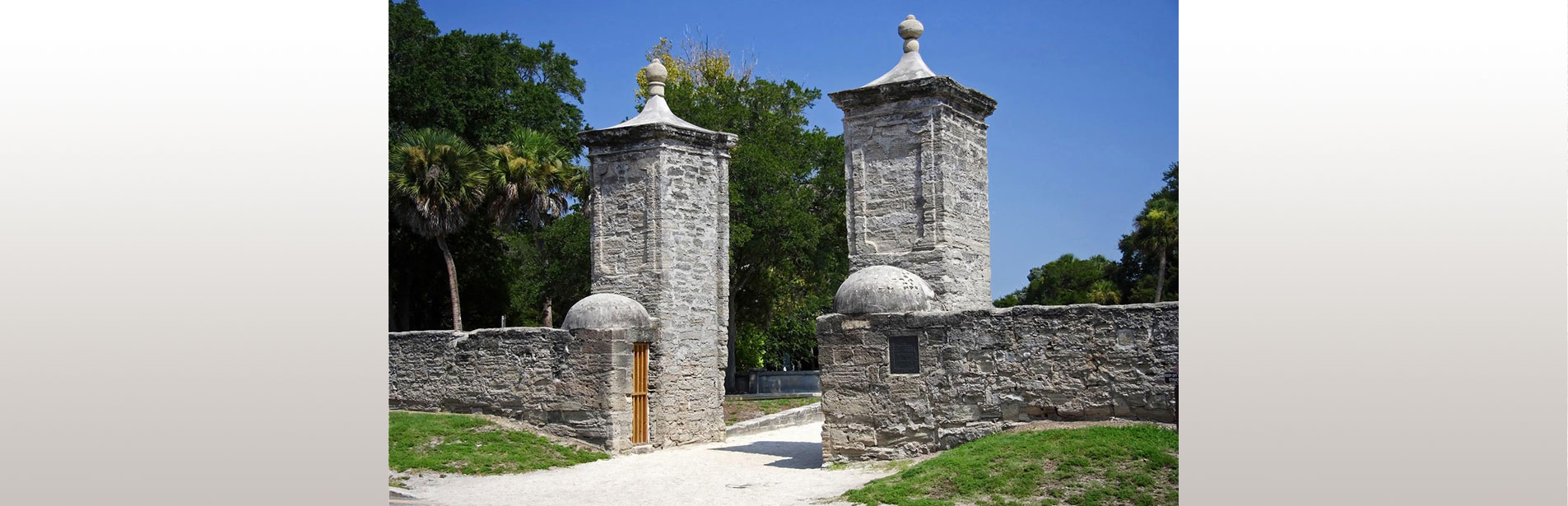
City of St Augustine

There are few places in America where one can capture the essence of Old World Spanish atmosphere in a modern, yet ancient, town. St. Augustine, Florida, is one of these places. Its history is diverse, filled with exciting dips between peace and wartime.
The story of St. Augustine began in 1513, when Spanish explorer Juan Ponce de Leon, formerly governor of Puerto Rico, came to Florida on an adventure. He is rumored to have been looking for the "fountain of youth" hinted to him by the local Timucua Indians. Once he reached America, he named the land "Pascua Florida," or "land of flowers" because the event took place during the Easter season. The name "La Florida" stuck and has been passed down to us in our present day. Since that day in 1513, Spain attempted without success to make Florida a colony. But each time, the hand of fate intervened. Spain decided to let Florida go.
This is when another European country decided to try their hand at colonization. French Huguenots - Protestants under the teaching of reformer John Calvin - were led to Florida by an able French sailor, Jean Ribault. They arrived on the East Coast in 1562 and built Charlesfort in South Carolina where Parris Island now lies. In 1564, Rene de Laudonniere, second in command and also a Huguenot, constructed the second fort, Fort Caroline, in Florida. The fort was located at present-day Jacksonville. The Spanish king, Philip II, decided not to let these incursions go un-punished.
He instructed Don Pedro Menendez de Aviles, a worthy admiral, to drive out the Huguenots and finally make Florida into a municipality of Spain. Menendez's voyage accomplished his aims; he captured Fort Caroline in September of 1565 - renaming it San Mateo - and massacred the French at an inlet sixteen miles from St. Augustine. This inlet is now called "Matanzas," Spanish for "slaughters." This act left Florida clear prey for the Spanish.
The story of St. Augustine began in 1513, when Spanish explorer Juan Ponce de Leon, formerly governor of Puerto Rico, came to Florida on an adventure. He is rumored to have been looking for the "fountain of youth" hinted to him by the local Timucua Indians. Once he reached America, he named the land "Pascua Florida," or "land of flowers" because the event took place during the Easter season. The name "La Florida" stuck and has been passed down to us in our present day. Since that day in 1513, Spain attempted without success to make Florida a colony. But each time, the hand of fate intervened. Spain decided to let Florida go.
This is when another European country decided to try their hand at colonization. French Huguenots - Protestants under the teaching of reformer John Calvin - were led to Florida by an able French sailor, Jean Ribault. They arrived on the East Coast in 1562 and built Charlesfort in South Carolina where Parris Island now lies. In 1564, Rene de Laudonniere, second in command and also a Huguenot, constructed the second fort, Fort Caroline, in Florida. The fort was located at present-day Jacksonville. The Spanish king, Philip II, decided not to let these incursions go un-punished.
He instructed Don Pedro Menendez de Aviles, a worthy admiral, to drive out the Huguenots and finally make Florida into a municipality of Spain. Menendez's voyage accomplished his aims; he captured Fort Caroline in September of 1565 - renaming it San Mateo - and massacred the French at an inlet sixteen miles from St. Augustine. This inlet is now called "Matanzas," Spanish for "slaughters." This act left Florida clear prey for the Spanish.